The Ballot Box Reviewed by Natalie Friend
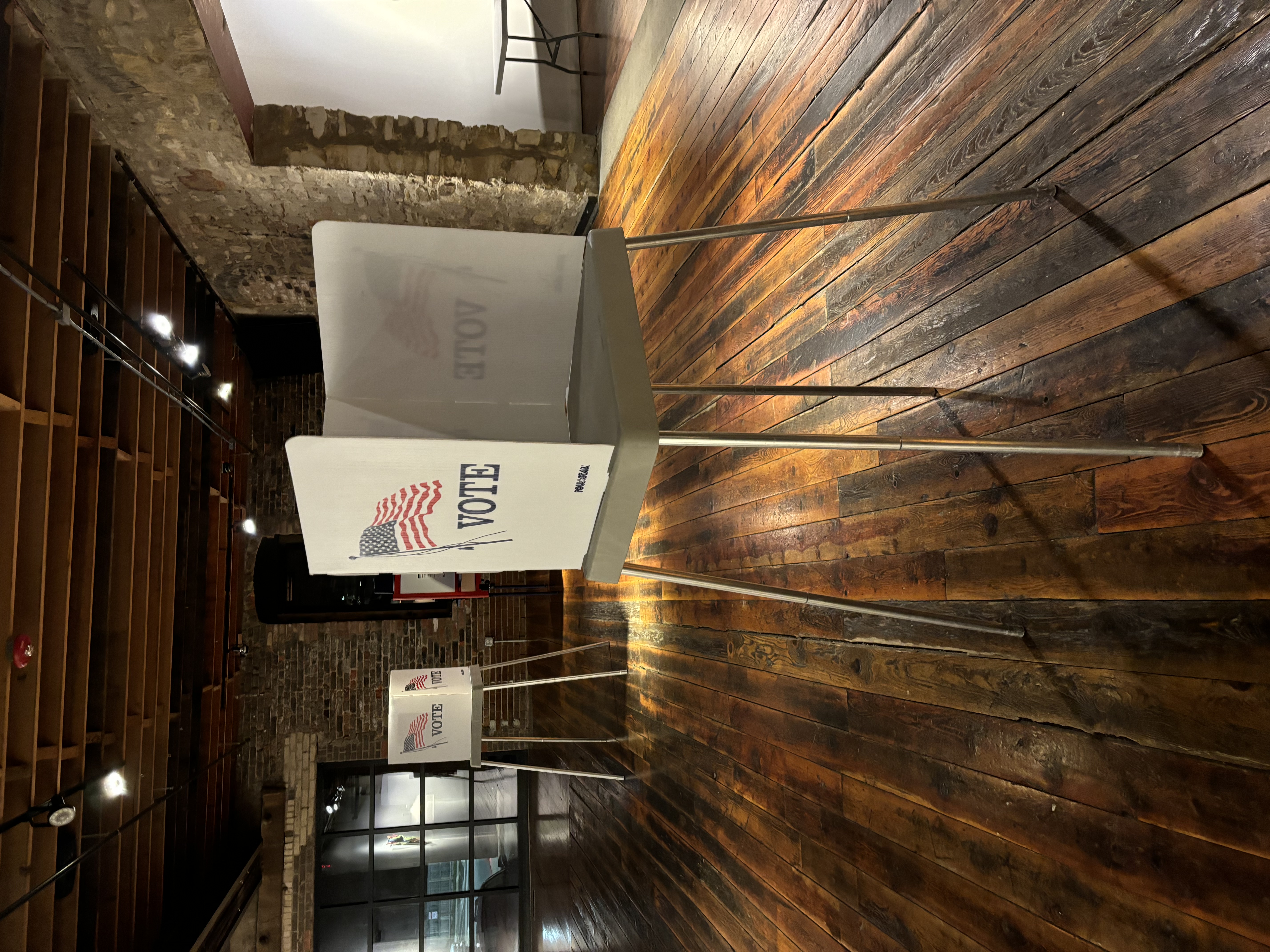
The car smells strongly of horse feed, and I’ve got a piece of hay jabbing me in the back. We’re idling at a stoplight while an unassuming black bag sits between us. Suddenly, I’ve got visions of dramatic car chases, silver briefcases, and action heroes in tight leather. It’s 8:27 on election night, and I’m a Douglas County, Kansas poll worker.
At the end of a 14-hour day, we’re completing our last task – driving the results flash drive, ballots, and other secure materials eight minutes from our polling place at the Cider Gallery to the county election office on 23rd Street. The journey is both infinite and brief.
I wonder: is this the moment the action movie comes to life? No. The drive passes uneventfully, and we successfully deliver our package, sign the custody forms, pass through the checks, and then depart. This unremarkable moment is what democracy looks like: quiet, procedural, entirely ordinary, yet incredibly monumental.
It hums around us, often far more quietly than you may think. Sometimes democracy isn’t an idea or a headline – it’s just a black briefcase in the backseat.
The ballot box, like democracy, is constantly evolving to meet the needs of the public. Kansas, like other places in the world, has had many iterations and changes in its voting laws, procedures, and methods over time.
In humanity’s pre-paper days, voters piled seeds, bits of broken pottery, or small balls to mark their choices. This is where the word “ballot” comes from – ball. The printing press and rising literacy rates facilitated a shift to paper ballots in the 19th century, a method that endures today. Technological advancements since the 1960s have made electronic voting machines and even Internet voting possible.
The ballot box evolved with a simple purpose: to collect and protect each vote. It has taken many shapes and sizes over the years – wood, metal, cloth, even computer. It’s scuffed, overworked, sometimes doubted, often ignored. It has been used both to expand freedom and to deny it. But the ballot box – whatever material form it takes – endures. Despite its flaws or challenges, it’s still the most ordinary miracle we’ve invented: a vessel for human choice.
I was eligible to make my first electoral choice during the 2016 presidential election. As a young woman, I was thrilled to be part of voting for the first female president in our nation’s history. Safe to say, it did not go the way I anticipated. The divisive political chaos, rising polarization, and national disillusionment that followed had a marked impact. My youthful optimism turned first to cynicism, then to determination. I spent my first years as an adult learning to believe in the political process again.
In June of 2022, women’s reproductive rights across the nation were rolled back to limits not seen since the 1960s. That summer, as the repercussions rippled across the country, Kansas was prepping for an August primary. When reproductive rights landed on our state ballot, I signed up for seven days of early voting, election day, and a hand recount — not to make a statement, but to feel like I could still make a difference.
If 2016 made me cynical, 2022 helped make me a believer again – not in politicians, but in the people. The ones who unlock the gym doors at 7 a.m. so their neighbors can vote and the ones who show up to cast a ballot, despite whatever barriers may be in their way.
We Jayhawk(er)s have always been democracy defenders.
Long before I ever unlocked the doors of the Cider Gallery on Pennsylvania Street, democracy was being tested here in Kansas. In the 1850s, this town stood at the center of the fight over slavery. Elections were rife with fraud as pro-slavery Missourians crossed the border to cast illegal ballots. Meanwhile, Lawrence’s abolitionist settlers were determined to outvote and outfight them. There were many competing newspapers documenting that time, including Lawrence’s Herald of Freedom. On October 27, 1855, it wrote of the ballot box: “upon its purity depended the glory of our institutions.”
Lawrence was burned, rebuilt, and burned again, but its citizens refused to give up on the idea that a free and fair election should determine its fate. This history lingers all around us. You can have beer at Free State Brewery, a cocktail at John Brown’s Underground, then check in at the Eldridge Hotel, abolitionist hideaway rebuilt after being burned by pro-slavery raiders. Even the KU Jayhawk, our mischievous mascot, is steeped in our democratic tradition: a hybrid creature born of resistance and resilience.
I think of the ballot box the way I think of the people who guard it – ordinary, stubborn, quietly magnificent, absolutely essential.
I only have six elections under my belt. This pales in comparison to most of my poll worker peers, many of whom have been handing out and counting ballots for a decade or more. Regardless of expertise, all Douglas County poll workers must attend mandatory training for every election, large or small. We follow strict legal requirements to ensure the sanctity and security of the ballot, including binding oaths, bipartisan teams, custody forms, checklists, and breakable seals. Everything is documented and tracked.
This work brings people from wildly different backgrounds together: Democrats and Republicans, young and old, passionate activists or nonplussed and nonpolitical. Despite our differences, we poll workers are all united and motivated by an enduring sense of duty, pride, and community.
We do have our quirks. Linda* is an avid horsewoman, oil painter, and mushroom forager. In addition to good stories, she always brings more than enough snacks to share. Jean, who seems to know nearly every voter by name, carries on the poll working tradition her mother started. When I first began in 2022, “Crazy Bill” wore the same silk American flag vest, weathered cowboy hat, and vintage election pins every day of early voting. As polling place supervisor, he ran a tight ship and always made sure everyone got a lunch break (even if he didn’t). Sydney was a high school senior serving – and voting – in the first election in which she was eligible. Her poise, maturity, and efficiency impressed us all.
Democracy is embodied in the people who make it work. In our neighbors, colleagues, friends, and foes. It’s the most ordinary heroism imaginable, and it’s all around us. The respect that poll workers have for each other, for the election office, for the voter, and for our country is clear. In them, I see the American experiment in miniature: earnest, determined, and intrinsically human.
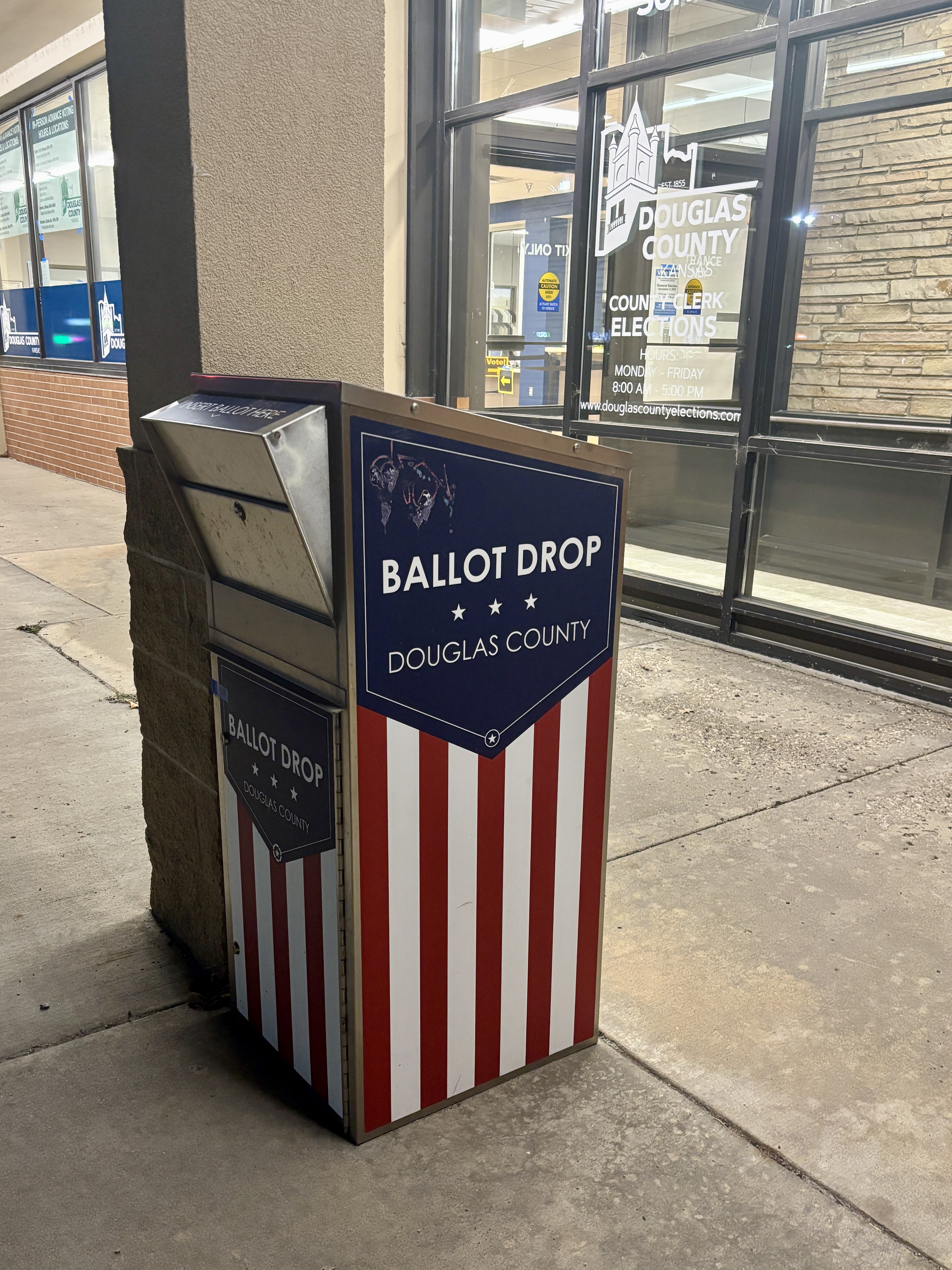
In Lawrence, democracy isn’t abstract. It’s in the street names, the bar signs, the murals, and the ghosts of printing presses past that once demanded freedom. It’s something you inherit, protect, and keep remaking. It’s in the flag-draped ballot box outside the old courthouse, the first-time voter you pass on the street, and the poll workers rising long before dawn.
It isn’t a guarantee, but a daily practice. A fragile, faithful, fought-for ritual.
For this, I give the ballot box 4 ½ stars.
*All names have been changed to protect my fellow poll workers’ privacy.
Natalie Friend is a master's in public administration student at KU and a local poll worker.
The opinions expressed here are her own and do not necessarily reflect the views of the county election office or of KU.